i cannot express to you enough that you literally do not have to get into a relationship. ever. you don’t have to get married. you don’t have to be dating. you don’t have to search for “the one.” you don’t have to have sex. you don’t have to deal with any of that shit if you don’t want to. even if you’re not aro or ace or anything. you can have attraction to people in any kind of way, and still not want to do some or any of it. it’s about what you want to devote your time to and what you find fulfilling or important, not “well people said i had to because that’s what they consider normal behavior.”
Amatopunk Masterpost
Amatopunk is a term I coined in 2021, and has gone through a few different editorial additions since then, mostly to accommodate for more diverse groups of people, and discuss more facets of amatonormativity. There’s a lot more to add onto since then, so I’m creating a new post to refer to in 2025.
An official page for it can be found on Neocities.
[1] What is amatopunk?
Amatopunk is a subculture and movement dedicated to rejecting amatonormativity in all forms. It disputes the notion that someone has to be in, or actively seeking, a relationship in order to be “normal,” that the way someone engages in relationships has to fit the amatonormative standard, and that any specific type of love or connection is what inherently makes us whole or fulfilled. It tells you to take a closer look at the way we define love, relationships, and other societal standards, and ask: “why? is this necessary?”
While the movement was first made in mind for those who are a-spec (asexual, aromantic, and other similar spectrums), it is not exclusive to them. In fact, it is not exclusive to any one type of person, community, or experience. It is centered around what you believe and how you view things, not any one specific label or experience. It is closely-tied to the queer community, but you do not need to be queer or lgbtq+ to be amatopunk.
Issues such as marriage rights for polyamorous and disabled people, destigmatizing a-spec identity and experiences, rights for those fighting to get a divorce or contraception, and rejecting notions, stereotypes, and pressure from those trying to force people to fit into amatonormative structures, are some of the different key priorities of amatopunk, though the discussion goes much deeper than these things alone. Amatopunk combines all factors of amatonormativity, and may touch upon other forms of oppression that can often intersect, such as ableism, misogyny, and racism.
Amatopunk is not, and never has been, a movement dedicated to normalize any kind of dangerous relationships, such as predatory, abusive, or incestuous ones. This is non-negotiable.
[2] The Flag & Symbols
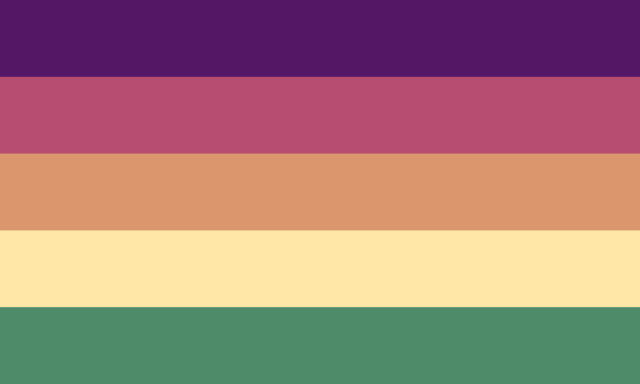
The amatopunk flag, posted at the top, was made with inspiration from a variety of different pride flags, but the individual stripes do not represent any one specific community. This is so that it can stay intentionally broad and inclusive as a political and subculture-based label.
As far as symbols go, when the term was created there wasn’t one considered specific to it. A variety of symbols have been used, such as the anarchist “A” with a circle around it, and icons of hands clasped together, but none are official, and none have been widely adopted.
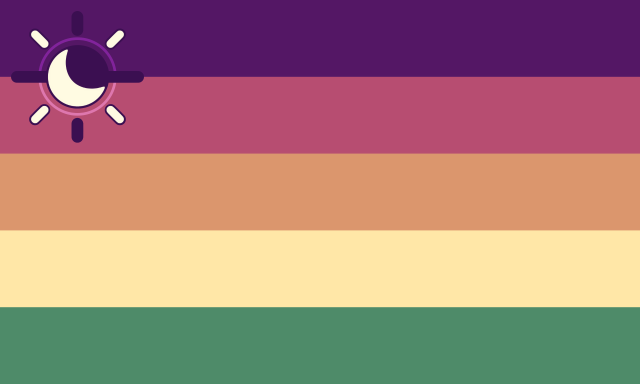
More recently, I decided to take a crack at what I thought could be a decent amatopunk symbol. I do not consider it “the” symbol, you can always make or use your own, but I thought it would be nice to contribute one.


These are the full-color versions, taken from the flag itself. There are a variety of alternative versions of these symbols, including a blank one and 2-color one, on the Neocities page.
The symbol was made in mind of many different groups of people. The eclipse represents a general “bond” between things, and how it is not innately romantic or otherwise. This can represent amatopunk and its focus on relationship structures, and could also represent those who are in or desire relationships while still ideologically aligning with amatopunk. The ring around the second image may represent people who orbit “around” this, such as those who participate in different, less socially accepted relationships, either due to discrimination, a different structure such as QPRs and waverships, or anything else. The beams in different colors represent the groups who may be entirely disconnected from this framework, either politically, simply by choice, or due to their identity. It may also represent those in a relationship with more than two people, hence why there is a plurality of them. The two connected lines in the horizontal center can vaguely resemble the “A” symbol mentioned before, with it going across the moon, representing the term’s political and ideological nature.
I don’t think any symbol can perfectly include every single group that can fit under a term this all-encompassing, but I did my best to include as much variety as possible. As stated before, you do not have to use it, and you can always make your own.
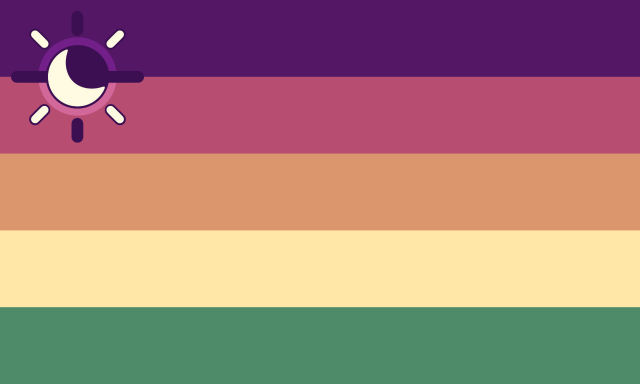
Here is the amatopunk flag with these symbols added onto it:
[3] Further terminology
- Amari, or Amarity, refers to an unspecified or “generalized” form of attraction. This can refer to someone who chooses not to distinguish different types of attraction, does not prioritize any one kind of it, or it may refer to those who simply feel a sense of unspecified attraction in some kind of way.
- Relationship Anarchy is core component of amatopunk for many; it refers to the belief that relationships should not be bound by set rules, aside from the rules the individuals involved mutually agree upon. It is based on the rejection of the traditional power structure that is the norm in our society.
- Affinity is a term that has been used in place of attraction or love among some individuals, as a way to describe having an… affinity for other people, but in a less conventional way.
- Amatosonas were created with direct inspiration from voidsonas, which relates to voidpunk. It refers to a depiction of yourself in “an amatopunk way,” or as an amatopunk-based persona. This has often been done with plant, floral, or fungal themes, due to how their relationships and general structures work in a unique way, and just because it’s cool. But, your amatosona does not need to fit any rules; it can be whatever you want. You also, of course, don’t need to have one of these