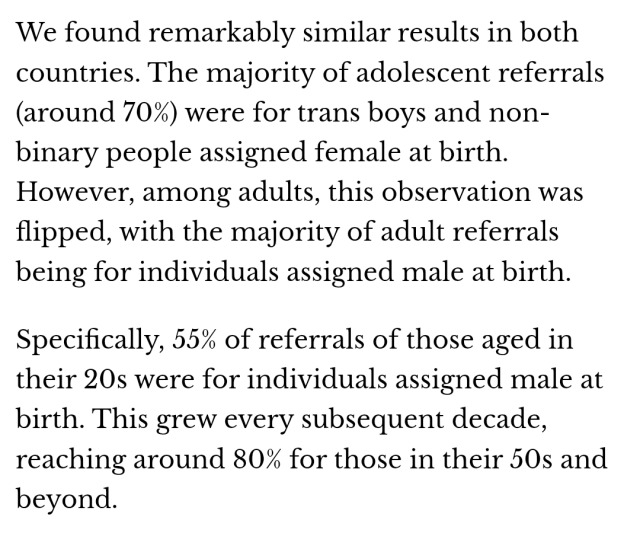
Trans misogyny is a unique type of discrimination trans girls and women face. It combines transphobia, the hatred for and discrimination against trans people, with misogyny, the prejudice and contempt towards women.
The impact of trans misogyny is far-reaching. During adolescence, trans girls experience higher rates of bullying and victimisation than trans boys and cisgender peers.
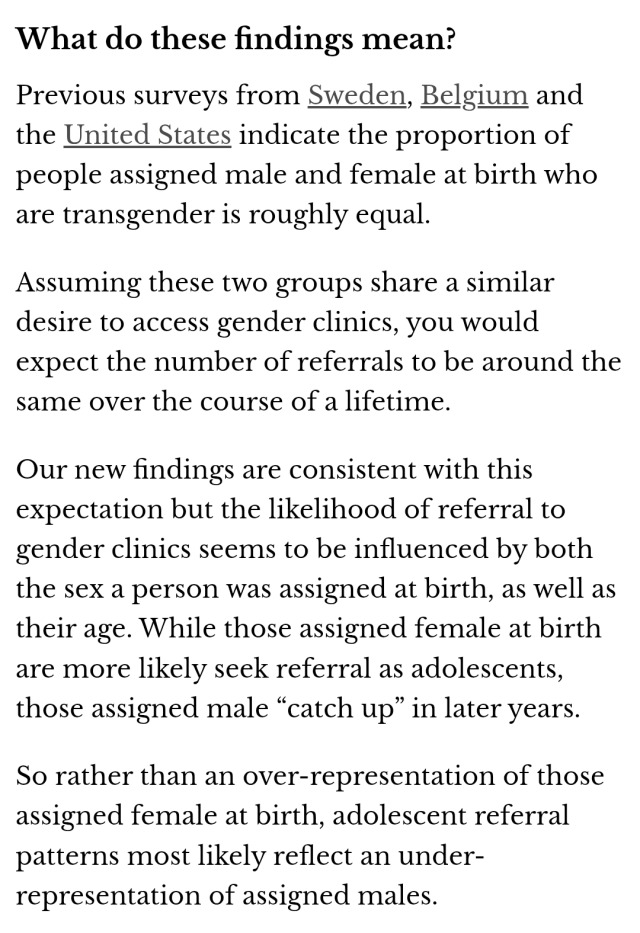
Faced with such daunting prospects, it seems much harder for trans girls to reveal their gender identity as adolescents at an already uncertain time of their lives.❞
(yes, the language and such is slightly off, the authors being medical professionals, gender specialists, but not, so far as I know, trans themselves—still, the whole article is very good in content and well-sourced)
This clip of Judith Butler is so good I just had to share it on my account. The way they intertwine feminism and trans liberation together isreally refreshing, I have GOT to read more of their books. The original clip is from an interview they had with @/politicsjoe!
[Judith uses both they/them and she/her pronouns, but has said they prefer the former.]
Transcript:
[The way] feminism began was by calling into question, received notions of what a woman is. They tell you, “you belong in the household.” They tell you, “you’re good for reproduction.” They tell you, “You’re not able to do that kind of work. You can’t engage in sports. You can’t be a public speaker. You certainly can’t be a politician. You can’t be an intellectual, or if you are, you’re never going to be quite as good.”
So what has feminism been about? It’s been about contesting received ideas of what a woman is. Why did we start women’s studies, feminist studies, gender studies? Well, we did because we wanted to call into question these presuppositions that had been taken for granted for too long.
So we ask the question, what is it to be a woman? Or what does it mean to be a woman? Simone De Beauvoir, “one is not born but rather becomes a woman.” Really? It’s not biologically… it’s not the biological function that makes you a woman? No, it’s not the biological function. It’s actually nothing specific about the biology that alone defines you as a woman. It’s part of the picture, but how you live that, way you deal with that, is a question of history. It’s a question of freedom. It’s how you negotiate your situation, which is a historically complicated one, where there are established norms and roles.
So feminism has always kept the question open, “what is a woman,” And refused to answer it. Refused to answer it on principle. Because we don’t know all the things women can be and do, and we’re not about to say in advance, “This is who you are. Stay within your limits. Stay within this category. We’ve decided this is what a woman is, and you have to live there.” No, we don’t do that. We’re a freedom struggle.