In the MOGAI community, there’s been the concept of nonbinary, then abinary, then all the way to xenogenders and beyond. The limit of how far a gender can go is very wide. But it got me thinking… what if some people’s identities are somewhat adjacent to where a gender would be, but isn’t a gender at all?
Some people might identify as nonhuman (otherkin, system members, and whatnot) and have a system of identity that doesn’t fit “gender,” some might just not fit any kind of notion for gender, and some might feel as though what they experience is completely broken outside of the very concept for what a gender is. There’s countless experiences just like these! For whatever the reason, that’s why the word “menre,” or just genre, is being coined as a concept.
A menre can be like a gender, in that it is an internal identity that may or may not reflect how one wants to present, interact in social situations, or just find most suitable for defining themselves, but is partially or fully outside of the notion of “gender” itself. It is not gender, it is menre. Some menres can be parallel or adjacent to gender, and some might be partly connected to gender, while others may be so utterly disconnected that they have nothing to do with each other.
Menre is an intentionally broad concept, and can have countless iterations, variations, sublabels, and experiences under it. Menre itself is not equivalent to the term “gender,” but its subterms are. Instead, mnre is the umbrella in which all of these non-gender subterms are grouped under. Not only can there be a million umbrella labels for specific menre experiences, but those labels themselves can be just as vast and countless as the term “gender” is, with all of its variations and sublabels. To put it another way, any menre variation has the capability to have just as many sublabels as there are gender identities.
To be clear, menre is not creating a binary dichotomy between gender and not-gender; menre is more comparable to how “nonbinary” partly or fully goes outside of the constraints of the gender binary. “Gender” in this instance is the “binary,” and menre is everything outside of that specific label.
“Menre” comes from the latin mens meaning “mind,” as well as the word genre, which roughly means class, type, or style. So, roughly, “menre” means “mind’s style.” I made sure that genre itself could be another word for this experience, since people might find that more accurate. Menre would be pronounced “mehn-rah,” like the word “men” and the end of “genre” combined together.
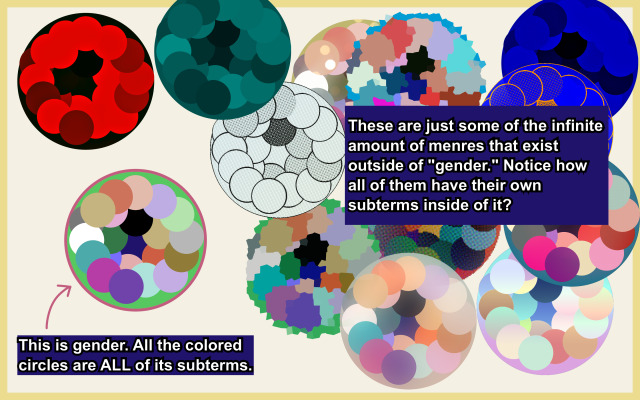
Here’s a visual representation:
So essentially, with menre in the mix, gender is just one sphere in a huge sea of similar identity frameworks. All of those “bubbles” have their own subterms. You’ll also notice that some look very similar to the gender “bubble,” while some are very different looking. Obviously this is a very simplified graph, since not everything is going to be a cut-off bubble and all have the same “shape,” (many menres are so far different from gender that they can’t even be compared) so don’t take this literally. It’s mostly just to show how menre is different from gender.